Showing posts with label Ideas. Show all posts

Contents


Opportunities for Creativity

Where Does Creativity Come From?

Perspectives from a Female Engineer

Opposed to Busywork

Volunteering : For the Win!

Word Power

Pondering a Tavern Tale

Self Correcting Systems

Good Ideas vs the Status Quo

Inspiration + Capability

Happiness is Not Juvenile

We're Still In Eden

Cause Or Effect


Friday, March 28, 2014

Opportunities for Creativity

This is a quick follow-up post to: Where Does Creativity Come From?

As I was watching a movie the other night, I realized there are a few specific techniques I've been incorporating into my life which have helped to spark my creativity, so I thought I mention them here too.

Turning Disappointment into Enthusiasm

The times when I've been really excited to watch a particular movie, read a novel, or play a video game, but it doesn't turn out as I'd hoped, I try to take some time to wonder about what it was that sparked my interest so much, and what I would have done differently to make it a more rewarding experience. Usually, there's something about the characters, the setting, the situation that is a really compelling and worth further exploration. It's something that resonated with some part of your own experience, that calls for further understanding. It indicates some interesting idea that you have to offer, just aren't quite aware of yet. Someone else wasn't able to make it take shape, but you can!

http://www.flickr.com/photos/lyteray/8654010430/
Copyright Laura A Knauth, All rights reserved.
Please contact me for any usage or licensing options.

I've found this exercise to be a gold mine of creative ideas. Instead of thinking you've wasted your money or your time, you become engaged trying to figure out where you thought the story should have gone, what aspects of the character you thought aught to have been developed, what would have been a worthwhile resolution? I usually have quite a few notes to jot down initially and also after letting these things rumble around for a few days.

There are a lot of movies and books out there, and plenty of them don't deliver. It's a map to buried treasure for you. Even the mostly great ones have some aspect to them you might have tweaked in some way if the artist had called you up personally for your opinion, right? So pretty soon, there you have it: a big stash of cool ideas all your own. For writing, I usually need about at least three interwoven compelling ideas to come up with what I think is a strong story: a particular setting interacting with particular characters that are triggered by some compelling scenario. Whenever one of these pieces is missing, I'm grateful for my stash of previously collected ideas. I thumb through my notes and frequently find just what I'd been looking for.

This doesn't have to involve just storytelling though, it could be anything. For photography, I go through a similar process for the pictures or paintings I look at. Maybe something about the overall structure grabbed me, but I loose interest when focusing on the details. I still find it worthwhile to identify what worked & separate it from what didn't. And even if I really like the whole picture, I still ask myself: if I was standing right there, how would I have framed it? what would I have tried to do, and is that more or less likely to work? That way instead of potentially being disappointed, you become either inspired or empowered. The goal is to stay actively engaged one way or another.

Noticing
As I go about my day, I've been trying to make a point of noticing some detail about some part of my experience that I hadn't noticed before. I've gone on hundreds of walks through my neighborhood at this point, but whenever I call on myself to pay attention and notice things, something new and unexpected never fails to be right in front of me. Hidden in plain sight. It's kind of like awareness training.

This doesn't have to be anything huge, just true & you hadn't noticed it before.  It could be a pattern on a manhole cover, new shoots popping up for springtime, a funny little bird chirp, whatever. You don't have to know where it fits in yet. Like kindling, it's all fuel for creativity, somehow, somewhere.

Reverse Engineering The Fantastic
If it was going to happen, what would it look like? This is a favorite question I ask myself to kickstart my creativity. You deliberately turn off your inner critic & just suppose that something you didn't think was possible could happen. Then, you try to build upon anything and everything you know to figure out it would work. So instead of spending your energy tearing down an idea, you engage your energy to built it up. It's a fun process and you inevitably end up realizing that with just a few tweaks to the initial premise, it's actually not so far outside the realm of possibilities as you previously thought. The story I'm currently writing started largely because I began speculating about a possible science fiction interpretation of Welsh fairy lore. You never know where these things are going to end up. It's like being a detective, but you're trying to uncover something true without putting too much pressure on yourself. I wonder if this is a process of many science fiction authors of the past, like Jules Verne or HG Wells, let alone actual feats of creative engineering. From Star Trek communicators to smart phones?

And as always:
What if? It's the classic spark for many a creative endeavor.

So there are a few more practical tips and exercises that I've found valuable for collecting kindling & firing up my creative engines. Hope these ideas help you too. :)

Blog Post by Laura A Knauth 

Wednesday, March 26, 2014

Where Does Creativity Come From?

http://www.flickr.com/photos/lyteray/8510186023/
Copyright Laura A Knauth, All rights reserved.
Please contact me for any usage or licensing options.
Where Does Creativity Come From?
From Wondering.
 
From asking questions, and pursuing the answers.
"Knock, and the door will open."

Unbinding Yourself
What limits your life options, what crushes your spirit is accepting someone else's limiting beliefs as your own. This is the case for external judgments about you personally, or any 'facts' you accept about life in general.  A little example: If someone says with certainty: "The Egyptians worshiped cats" and you accept their opinion as truth. You've just limited yourself. Some limitations are subtle, some are more obvious; both can have big consequences. As I've been doing historical research for my novels, one of the most valuable skills I've learned (and realized it applies just about everywhere in my life) is to put a mental "in your opinion" after every declarative statement that crosses my path. It's such freedom!
 
And even for personal matters, this approach applies to critics, bullies, all authority figures alike. Because what if they are wrong? No matter how sure they sound, if you are the one who accepts their incorrect opinion as fact, you are the one who's limited yourself. In my little example, I would digest the statement: "Egyptians worshipped cats" as: Egyptians depicted cats in their writings. It's someone else's interpretation that this involved "worship". That opinion goes in my mental slush pile. (Symbolically, a big bucket of proposals that are not likely to get any of my 'funding,' so to speak.) I might come to the same conclusion, but maybe not, and certainly not by default.

Now, it is still useful to know what everyone else assumes so you can respond effectively to your environment, but that doesn't mean you need to accept their assumption for yourself. To wrap up the example: just what the Egyptians were truly communicating by carving representations of cats remains an open question; it's a placeholder as you continue more research to sort out the rest of the puzzle. (Incidentally, I've become increasingly convinced most of the ancient writings are symbolic, not literal, which makes all the difference … BTW, everything seems to point to an aspect of the development of consciousness, but that's for another blog topic and future novels.)

There's just one small example, but it's shocking to realize how much of the history books, news shows, and all manner of 'common knowledge' are just opinions. Adopting opinions as facts ties you to the status quo. It's fine if the status quo is great, but what if it's gone off track? How can you find a creative solution if you are confining yourself to someone else's false opinions? Your mind loves solving problems, but can't do it if it's cluttered with false associations. So, learn the art of mental digestion: separating facts from opinion, and unleash your creativity!

Mental Digestion
It's not all or nothing. The art of mental digestion is kind of like the process of digesting food. You don't just inject food directly into your veins; even the healthiest food would become toxic if undigested (except apparently for fresh coconut water). Your body transmutes the food molecules from what you ate into something useful to build your cells and discards what it cannot effectively process. The process of mental digestion aught to be the same. Instead, we are raised to memorize every word of text books, injecting the material directly into our minds without filtration, without transmutation. We are strictly graded through school for 100% absorption, as if injecting that content directly into our veins. It's kind of like downloading a program directly from the internet without running a virus scan. Risky!
http://www.flickr.com/photos/lyteray/8598300385/
Copyright Laura A Knauth, All rights reserved.
Please contact me for any usage or licensing options.

Now that I see it in this way, accepting whole heartedly the best known methods of even the most illustrious authority figures, the most revered historical figures, is a risk I can no longer take. If all is well, the extra step of checking everything, of running your own virus scan, might not be necessary, but if you are feeling constrained, uncreative, or things are beginning to go awry, it might be worth a look to reconsider what you had accepted as obvious truth.

We are in an era where authority figures assure us they've checked everything 'for our safety' and therefore the most rational thing we can do is accept their best known methods. I bought into it for so long, but now disagree. I think each person individually is capable of sorting out the best solution for the most important issues that effect their own lives. Medical, financial, career, world view, whatever it is: No approval needed, no waiting for statistics needed. It's a difficult transition process to look to your essential self for support, not external authority figures, but it has been one of the most freeing experiences of my life. Like a tree that has been bound for years 'for safety' to protect it from the high winds, the trunk has become all spindly; now there is a danger when cutting those bindings that the spindly trunk might fall over. It's a gradual process of learning how to reliably depend on yourself, to responsibly strengthen your core. But you have to start somewhere. Bit by bit, from here, forward.

When you are prepared to extract only partially what you hear, identify and deprioritize the opinions, you can safely consider an infinitely wider range of experiences and find some value in them all. (It's true, time and energy is a factor, so it is beneficial to put yourself in scenarios where you expect a high priority return on investment.) It's a challenge; I'm not saying authority figures can't help, but just to be mindful there's some tendency to get boxed in so much that you deprioritize your own authentic judgment. And with this approach you realize that some important tip can come from just about anywhere, so you pay attention, you become more appreciative of more human experiences. Maybe the garbage man, maybe someone posting on their blog, maybe anyone at all knows a health tip that has not yet been formalized by medical science. If your mental digestive fire is strong, you might figure out how part of that tip cap be applied to improve your life. Just saying...

Another example: There are many books I've read while doing historical research that I consider pivotal in shaping my current understanding and helping me frame future novels, but I'm hesitant to share them because I actually disagree with the author's entire premise. ;p  What I monumentally appreciate is the authentic data points those books uncovered. Once I extracted those facts from the author's opinions, I found those books to be immensely valuable. But if I recommend the books here as some of my favorites, people would probably assume I agree with every word or even most words which is not the case at all - doh! I suppose it's like finding the particular piece you were missing; it's not the same for everyone.

Conclusion
By strengthening your own digestive fire to extract more useful data from a wider range of experiences, your creative impulse, your pattern matching skills have such a wider base of useful material to draw from. I have found it greatly improve my own creativity and perspective. This approach also undercuts elitism and values the perspectives of more people. I say that is good. So, if you're looking to boost your own creativity, I recommend these tips to remove artificial limitations, broaden your scope, and let your inner wondering go to work!

Blog Post by Laura A Knauth  

Monday, March 24, 2014

Perspectives from a Female Engineer

Though I hardly paid any attention to being specifically a 'female' engineer while I was at school or in the workplace, I realized my perspective on the topic might be helpful to someone, particularly since I never even considered the thought of being an engineer even once until the month before I started college. Maybe (hopefully) the situation has drastically changed by now, but up through high school, I didn't even really know what an engineer was; if someone would have asked me, I would have probably said a train operator. ;p  So, how can you know what you want to be when you grow up if it isn't even on your radar?

I was always proficient at math and science, but was the only one in my senior year high school math class who didn't initially sign up for a field trip to tour the engineering school at my local university. When I realized that everyone in the class was going on the day, I think I decided, 'why not?' & scrambled to get on the bus after all. I had been interested in just about everything at school but had no particular career path in mind. (Unfortunately, I was too scared of being an entrepreneur at the time, so never considered you could potentially forge a responsible career for yourself in something like writing or photography. Another blind side on the ol' radar, for another post …)

But anyway, I realized that the engineering degree plan looked essentially like my standard high school class schedule. And also, almost all of the classes were mapped out (only two or three elective slots the entire four years). Since I was bewildered at how to put together my college class schedule to work towards a degree, I found the defined plan of the engineering curriculum a relief. I thought there was no reason I couldn't give it a try to see what happened. By that time, I had figured out electrical engineers did things like work on computer chips. The Pentium had just hit the market and I thought it would be really cool if I could work on something like that one day. (And six years later, I found myself doing exactly that. :)

Being Female in a Mostly Male Workplace

The first class I took where I was the lone female among a classroom full of guys, I quickly realized that if I did the work and showed I wasn't getting any special handouts, the topic of gender in the engineering environment was absolutely a non-issue. I was a bit nervous initially, thinking I might be belittled or bullied or something, but I can't even say I noticed a hint of any negative undercurrent related to me being female at all. Discussions almost always centered around some sort of problem solving with everyone focused on the task at hand. That continued straight through from college, grad school, and into the workplace.

I think there was one comment in my 18 or so years in an engineering environment where one person asked me something about my hair after a meeting. (In a nice way, just totally off topic.) It actually threw me for such a loop that I probably paused for several seconds honestly trying to figure out what language he was speaking. ;p I was probably thinking through all the engineering acronyms to figure out what something called H.A.I.R. might be, and what it had to do with our project. Ha, ha. So yeah, while on the job, very rare to be talking to fellow engineers about anything other than engineering, in my experience.

The only real effect I noticed about being the lone female in a room full of engineering guys is you stand out more. I suppose that is added pressure. Sometimes it's fun: unexpected people wave hi to you as they pass by & you're pretty sure they are in your class or on your team, but can't place them, so you just wave hi right back (and try to remember more people for next time). On the other hand: I was highly motivated to be as useful & sharp as possible which I think did take a hidden toll, but that was my issue, nothing anyone else did or said. (I was the kind of person who would have thought a 'C' was failure, an indication I was on the wrong track, but most of the guys would probably have interpreted a 'C' as 'average', and continued on with no problem.) I suppose in an age where some extra scholarships were preferentially given to females, I was highly motivated to show that my grades were what got me there, not any special favors.

The Worst

I can honestly say that the worst treatment I ever received as a female in the field of engineering was from a women's support organization: WISE (I think it stood for Women In Science and Engineering). I was usually so busy through college that I didn't even think to join any special groups outside of class, until the last few months before graduating when I'd heard a recommendation to join this women's organization which was offering $500 for being in their program. Since it involved attending a few meetings, writing a few essays, and doing some outreach, I thought: Why Not? So, I completed all their checklists and received a mock $500 check at the final banquet where they touted my academic accomplishments as if they were their own, and then … they of course refused to honor the check, quoting (rather hostilely, I might add) some bureaucratic mumbo jumbo. They were just using me. What a waste of time and human spirit. And I had been banking on that $500 to buy supplies for grad school, too ... sigh. I would not recommend any fake support groups to anyone in college. Just do the work to develop your own character and capabilities, because that's all you need to apply for grad school, or a job, or anything really.

Actually, there was one other bad situation at work where a creepy old guy sent me an offensive email; but I replied via email (so it was on record) telling him not to ever contact me again, and that was the end of that. I think there are a few guys from older generation who are honestly bewildered to see a female in engineering, but if they comment at all, it's usually something like: "Golly Gee Willikers, a female in engineering? Never would've thought it." Which is totally benign: amusing actually. It's as if they honestly can't believe their eyes.

The younger guys don't even seem to give it a second thought. (Now, there are definitely some jerks out there, but I'm not counting them as part of this blog topic if they're jerks to everyone.) Maybe I was fortunate, or just listened to my gut to maneuver myself into good teams, but most of the people I worked with were absolute gems. Many became good friends. (I still remember going to see the Ballet around Christmas one year with about four engineering guys. Looking back on that, it's kind of funny, but at the time, it just seemed like hanging out with my work buddies.)

Summing It Up
 
So, if you're wondering what it's like being a female in the technical field of engineering, I've found that if you just do the work helping to solve problems, the guys are happy to see you. If anything, you're just changing things up a bit to make it interesting. That's my experience anyway (in both electrical and computer science engineering). One caveat is that I always steered away from management positions (which may be a different story); the politics of it just never interested me at all. There might be some lingering machismo good 'ol boys attitude in upper management, but since I have no experience there, so it's not fair to comment. I was always interested in solving technical problems, so kept maneuvering 'sideways' in my career to keep learning new technical skills (probably not to the benefit of $$, but certainly for my soul). It's just what I was drawn to.

But in general, if you've never considered engineering as a career option, know that the coursework in college is essentially just an extension of high school. If you can do it there, you will most likely have no extra troubles with it in college. Engineering is basically a big vocabulary lesson; after that, it's common sense and problem solving, as with any career, I suspect. And if you know someone who might be intimidated at the prospect of being a lone female engineer in a room full of guys working on a technical problem, in my experience, it's all about the work and nothing about appearances. As it should be. Go humans!

Blog Post by Laura A Knauth

Saturday, March 22, 2014

Opposed to Busywork

I had to rant today about the waste of human potential that is busywork. Over the past election cycle, there was much talk from vaunted economists across the news shows about economic policies to stimulate the economy in a way that amounts to paying people to 'dig ditches and fill them up again.' And lo, over the past several years, I have been stopped countless times in long lines for road construction where people are literally digging ditches and filling them up again. (Most of the roads had already been recently resurfaced and were in fine shape.) A sign usually stands nearby proudly declaring: "Your Tax Dollars At Work." I am not impressed.

The idea seems to be that the government wants to pump money into people's hands so they buy more things and stimulate the economy. That may a fine strategy and am not debating it here, but if that's their objective, why give people busywork to take up all of their daylight hours in the process? Why waste their energy like that, their creativity? It's an insult to human ingenuity not to mention productivity.

If you truly intend to stimulate the economy with the true spirit of freedom, instead of paying people to burn energy (busywork), offer a grant to people who present a reasonably viable entrepreneurial strategy. Why not essentially give them a boost to start their own business? The very material prospect of receiving funds if you can come up with a business model would encourage people to really think about what they could offer. It would engage people's creativity, their enthusiasm, their true hope for what they can contribute to the future.

Some new businesses may indeed fail, but the experience for those new entrepreneurs would still be incredibly valuable, and would help inform better strategies for their future endeavors, whatever they may be. And at the end of the day, a failed attempt at starting a business would leave that person (and the environment) no worse off than if they had spent that energy digging a ditch and filling it up again. Regardless of the outcome, it would encourage a certain spirit of integrity, ownership, and authenticity.

And many of these new businesses would succeed, many by filling a demand for a currently unoffered service. Who knows where that creativity could lead? What unexpected options it could bring to the economy? More options and more stability. I suppose this general idea of an entrepreneurial spirit is similar to microcredit or microfinance in that it sees the dignity and value in what the 'masses' have to offer.

Busywork is bad enough for children and teens as a kind of 'babysitting' in schools, but it continues in subtle ways through adulthood with different fancy sounding names like: Keynesian economic policies. Is it to bamboozle people, or do the policy makers not realize how amazing people are if given the chance to think? Busywork treats adults like children; assuming they won't do anything productive if left to their own devices. We can do better! People can be amazing if given the chance, and especially if given incentive to be inventive. Get the creative juices flowing!

End of rant - thank you. :)

Blog Post by Laura A Knauth

Wednesday, March 19, 2014

Volunteering : For the Win!

I had forgotten the many benefits of volunteering, but recently remembered it was one of the lessons I'd taught myself way back during high school. I remember spontaneously deciding to volunteer to help setup the photography darkroom before class: I wanted to learn about how to mix the chemicals and learn more of the 'behind the scenes' technical details about the equipment. Not only did I gain the sense of satisfaction from reliably setting up the darkroom so we could all produce our creations, but I ended up establishing a much stronger relationship with the photo teachers on the campus. In that position, you can't help but learn random tips and tricks along the way: hearing about photo contests, learning about new equipment or techniques you would have never thought to even ask about, and other opportunities here and there.

One of the big bonuses happened after I graduated: my college charged a prohibitive fee for their darkroom usage (I was going to put all photography on hiatus), but due to the connections I had established with the high school photo teachers, I was able to continue using my old high school darkroom and other photo equipment all throughout my undergraduate years. :) I don't think there would have been any way I could have negotiated to use the high school darkroom during my college days if I hadn't volunteered there during my time as a student. Valuable life lesson!

Producer Not Consumer
Since I'm in the process of starting a new career, I've cut back on membership to places around town that I love visiting, but can't justify the expense right now. I recently realized that volunteering at these places is a wonderful way to continue my involvement 'for free' and even significantly enhance the experience by meeting the people behind the scenes and learning so much more than I would as a paying customer. We're talking botanical gardens, wildlife reserves, nature parks, museums, galleries ... Whatever your interest, I highly recommend investigating volunteer opportunities. When there's so much conditioning nowadays to be a consumer, it's very refreshing to realize when you are volunteering, you have become a producer of what you love.

Foot In The Door 
When trying to break into a difficult industry (publishing, photography, ...), volunteering drastically reduces your cost to an organization. Maybe some training overhead, but otherwise you position yourself as a no-risk trial run for what could turn into a career down the road. It's a gesture of goodwill, and people are generally so appreciative for the help of someone with initiative and drive to learn. It's a nice change of pace from a 'job' environment. And if it's not something you really are enjoying after all, you are the one in the driver's seat who can try something else without drama. Hopefully though, if you are a good fit for that environment and prove yourself reliable and fun to work with, you will probably be on their A-list and the first to know about any job opportunities or other 'insider' insights. If nothing else, you are in a great position to make some strong networking contacts.

Networking and Opportunity
Many times, it's the people you meet and unexpected opportunities you hear about that make the largest long term impact on your life, rather than a short term paycheck. That's where volunteering comes in. With your wider range of contacts, you hear about random opportunities, tips, and other insights that might not have otherwise crossed your path. Many times in life it's who you know that leads to 'lucky' breakthroughs, and volunteering at something you love to do can help shine a light on opportunities there you didn't know were available to you.

Finding Volunteer Opportunities
I've either contacted individual places directly to find volunteer opportunities (many have websites with volunteer listings), and I also found new places to volunteer that I hadn't known existed by doing a Google search for 'volunteer' and city name. I found a few websites that list pre-scheduled local volunteer events posted by various organizations. It's been a fun way to explore the city!

One More Example
http://www.flickr.com/photos/lyteray/8730386392/
Cherry Blossom Fantasy
Copyright Laura A Knauth, All rights reserved
I just got back from a volunteer session in a local nature park where we helped propagate local plants. I didn't know what to expect, but it was such an interesting learning experience. Turns out, you can cut new shoots from many different trees and shrubs in springtime (we looked for 'pencil width' shoots just as they were just budding), clip any stray stems, put the stick in at least 5 inches of soil (with about a foot out of the soil), and with regular watering, voila! new plant. Amazing :)  The measurements would change depending on the type of plant, but that's an example. (We were focusing on large shrubs.) Gardening costs can really add up, so I unexpectedly learned how to save $$ in my own garden for the future! Hey, if you have a neighbor with a gorgeous looking plant, you could just ask to take a small clipping to grow one of your own. State forests in my area appear to allow taking clippings for small personal quantities. For national forests, you can apply for a free use Forest Products Permit. (I'd put a general link if there was one, but it looks like each forest has it's own permit, so you'd have to find the one for your area.)

So, above and beyond to thinking of volunteering as giving back to the community (which can be wonderful all by itself), I've found volunteering at something that fulfills your hearts desire simultaneously offers so many of these other unexpected benefits ... not to mention the high likelihood of making new friends with shared interests.

Hope these tips help send more opportunities your way.

Blog Post by Laura A Knauth

Saturday, March 15, 2014

Word Power

The Art of Rhetoric

Why don't they teach this in schools? As I was doing research for my novels, I stumbled across the subject of rhetoric: templates of speech that create resonant power and drama. I feel I've found a missing piece of myself! Turns out, the most memorable authors throughout history, the most memorable speakers are most likely using the techniques of rhetoric. It's a skill they either pick up by reading other books steeped with these patterns, or study it directly as was done in Ancient Greece and through the nineteenth century.

From Shakespeare to Dickens to Melville to Emerson and Lincoln (just to name a few), all of these authors have used rhetorical devices to communicate their ideas. And perhaps, that has made all the difference? Having a compelling idea is one thing, but having the tools to communicate that idea in a compelling way commands attention and adds undeniable style. There are these two essential factors to make something useful happen: inspiration + capability. Rhetoric provides the capability to support inspiration. 

http://www.amazon.com/Farnsworths-Classical-English-Rhetoric-Farnsworth/dp/1567923852/ref=sr_1_1?ie=UTF8&qid=1394939236
(I don't get anything for the link;
it's just for reference)

I've read several books on rhetoric by now, but the best so far has been:

Classical English Rhetoric
by Ward Farnsworth

I checked it out of the library and took so many notes that I was basically transcribing the book, so I finally just decided to buy it outright. ;p  

Aristotle is the classic source for rhetorical techniques and it looks like there are several free options to download his work on archive.org. I haven't looked through them yet for the best one, but I'll update the link when there's one in particular that I end up finding most valuable.  I liked Farnsworth's book because he includes many literary examples from authors frequently studied in school, and I find his concise organization of eighteen particular rhetorical devices (with many variations) to be incredibly helpful.

So often in students are almost made to revere literary 'geniuses' of the past, to feel inferior themselves, when in fact, these authors and speech writers have become skilled in basic rhetorical patterns of speech. Not to take anything away from them, but study rhetoric for yourself so you can reap the benefits too; power to the people!

Breaking the Rules
The one comment I've received so far on my writing from professional publishers is that I 'need more sentence fragments'.  Well, as a college grad, this remark initially made me scratch my head. But, my writing was grammatically correct; but no snarky people could nitpick anything; but ... but ...  Well, I now have the sense of what that comment implied. Rhetorical devices are not something you would use to get an 'A+' in grammar school. In fact, using rhetoric would probably get you points docked off a 'perfect' sentence structure. Grammar school is one thing, true life is another; what's more important, perfect sentences, or powerful sentences?

The key with knowing rhetoric, with infusing yourself with the underlying patterns, is that you know inherently come to know when to 'break the rules' to create deliberate power and drama. Rhetoric is about learning to trust your ear, not just your mind. It's motivation to free yourself from rigid grammatical bonds. It's about staying true to the underlying purpose of the sentence, and knowing why you organized your sentence in that particular way. It's not about 'breaking the rules', but deliberately communicating more effectively. Yeah!

Mental Jujutsu
Even if you don't have aspirations to be a writer, at least take a look at these rhetorical devices since countless politicians (or their speech writers) employ these techniques. If nothing else, use it to immunize yourself from the emotional pull evoked by these rhetorical patterns; it's mental jujutsu! Politicians can use it to incite people to 'join the cause', to pull the population this way or that. At by studying rhetoric yourself, you can separate the technique from the actual idea itself to gain better perspective.

I was so relived to discover the art of rhetoric for myself. It really does imbue prose with a kind of poetry. I have a long way to go to decondition myself from rigid grammatical dogma and instead absorb these underlying rhetorical patterns into my very bones. I'm excited to do it though because I can see it's the path to true creative freedom. Hope exploring rhetoric helps you too!

Blog Post by Laura A Knauth

Sunday, May 26, 2013

Pondering a Tavern Tale

I read this old parable a long time ago and have always kept it in mind. I couldn't find the original source material, or the original author, so to paraphrase:

A man walked into a tavern, and found a group of patrons arguing about how many teeth are in a horse's mouth. He suggested they all take a look at the horse in the stable outside to find out …
at which point they promptly beat him and tossed him outside.

Why bother measuring what can be measured when you could just have a contest about who has a bigger ego? Sigh. Take a look at most news 'shows' today and you will likely see glaring evidence of the same bad behavior as the author of this parable was warning about hundreds of years ago. Life is complicated enough without distractions from the cult of personality.

Critiquing the Skeptic
While you might expect salesman types (or news personalities) to be most susceptible to personality-driven, ego-based arguments instead of fact-driven focus, I'd caution for the same vigilance even for the most esteemed in the academic community as well. Most modern academic inquiries seem to be based on skepticism - that is, putting proposed ideas to a rigorous test, then either: finding any crack or failure which would invalidate the idea, or else having found no failure, giving the idea an official stamp of approval. A valiant attempt. But unfortunately, I think this approach ends up discarding too many good ideas, too many true facts, along the way.

If a champion of an idea makes a mistake in their presentation, the ultimate idea may still be right even if the implementation by that particular champion is flawed. How many times have you seen a news clip, video, or read a quote from a random person in the news who's main idea you agreed with, but cringed at their bad choice of words. It's a case where you know the underlying idea is better then how it sounds. All too often you see the result: bad presentations create easy 'straw men' that are easily dismissed or ridiculed. The lesser argument can appear to 'win.' In this way, skepticism can lead to these same personality-based arguments overshadowing truth-based inquiries. The danger is when such criticism deters others from ever looking at that badly framed idea again. It creates a blind side where potentially real truths are left unknown, unmeasured.

Skepticism takes a disastrous turn when questions are intended to destroy rather than to understand. It becomes a vehicle for another top-down, authoritarian system so pervasive in our modern society: Only validated experts are qualified to examine data. It's as if they presume to valiantly eliminate thought viruses from infecting a supposedly childlike population. Destroying ideas that challenge the system becomes like a feather in their cap, and it's 'for your safety'. (Same goes from my experience in the corporate world, where people are also rewarded for killing new proposals 'to meet schedule' just as you might expect they should be rewarded for creating new ones.)

Look for Shreds of Truth, not Cracks of Failure
But what if everyone took on that responsibility for themselves? While it is definitely valuable to understand the best currently accepted theory from the experts, I would caution very strongly from stopping an inquiry there. Now if this latest default position happens to meet your needs, then you're done. But if you are still dissatisfied with limited options, I don't think it's reasonable to despair, thinking the official line is the only reasonable course of action. I think it's reasonable to hear other possible options, regardless of the source. I love this approach; it can be so invigorating and inspiring. The key is to look for shreds of truth, not seek cracks of failure. With this approach, you are not an unsuspecting childlike consumer that must be fed only sanitized options, you are autonomous investigator, looking for glimmers of hope in a motley universe.

For example: rather than reading only approved textbooks or talking only to an approved authorities, you could read fringe books, listen to podcasts, or watch YouTube videos just to find one useful phrase or idea (although hopefully you can prioritize so the odds are better). And you will definitely have to activate your best pattern matching mind filter (serious discrimination skills needed) because there will likely be a lot of misguided tangents to sift through. But for all that, you may find that just one phrase becomes like a key, unlocking a whole new viable approach. That one idea could be life changing, opening up huge opportunities or cost savings. The very approach you stumble upon from random fellow human beings might become lauded by experts in the next 50 years, but has just not been officially recognized yet. It's a common blindside in our society. How often do you hear: "No one could have seen it coming."   … Really? How about taking a look at the people who were thrown out of the tavern, so to speak.

Remedy
Going back to the parable, if too many useful facts are being ignored due to the tendencies ingrained in modern society, I think one good option is to figure out how to make the best use of that true information. Could be a business opportunity, or just something simple you can incorporate to benefit your own life. Anyway, good ideas are usually just a fraction of the total energy compared to what it takes to convince someone else the idea is right. Why bother with that anyway? Such arguments really do seem mainly ego driven.

It could be because I'm coming from an engineering background, but I say the best remedy for unrecognized (or ignored) facts is to find out a useful application of those facts and then test it out yourself. If the idea really was bad or the fact turns out to be useless, then at least you didn't expend your time and reputation defending it. If the idea is truly good and useful, then you will benefit (since knowing something that is true, but no one else believes is technically a business advantage). And when you succeed, people will probably notice and then ask you what you're doing. Problem solved; no yelling. Seems like a decent plan to me. :)

Blog post by Laura A Knauth

Wednesday, May 22, 2013

Self Correcting Systems

There are many paths, 
    but some are more efficient than others.

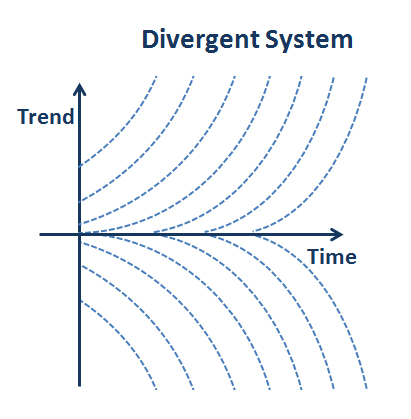
I see huge benefits to setting up or supporting self correcting systems vs micromanaging self destructive systems. That may sound obvious, but I think many inefficiencies in modern life stem from continually supporting essentially destructive systems without realizing that a better option might be available; that is, investments that change the nature of the system so that it automatically corrects itself in the future. As a first step, here's a simplified picture of these two types of systems:

I am attempting to show the trend of two systems over time. In my example, the ideal functioning of the system is in the center, along the Time (or horizontal) axis. In the day to day functioning of the system, noise or external events can bump a data point away from ideal. As time continues to increase, the datapoint, the result of the system, would follow one of the trendlines shown. Once the ideal functioning of a divergent system is perturbed, the trend of that system will follow the trend lines of the divergent chart, leading ever away from ideal. If a point on the convergent system is perturbed from it's ideal, over time, the convergent system will trend back toward ideal, re-establishing the balance point with minimal external effort required.

There is a useful 'path to victory' in both systems (along the Time axis), but divergent systems are high maintenance, while convergent systems are self-correcting. Divergent systems require authoritarian oversight and constant micromanaging to make sure they continue to function properly; and there is a constant danger of over-correction. 'Fishtaling' is a constant threat when correcting divergent systems since what was supposed to be a correction can instead cause the system to spiral out of control in the opposite direction. Only tiny deviations can set off a chain reaction that can cause a response that moves far away from ideal. But once you setup a convergent system, further maintenance is minimal. The convergent system 'fights' external inputs that seek to push it off course. Sounds like a good idea to me!

For some real world examples: you could think of driving your car in reverse as a divergent system. It can be done in a pinch, but extreme care must be taken with every course correction to ensure the car does not veer wildly out of control. A much more stable system is driving your car forward. Once you set your course, physics supports holding the car in that line.

You could say fission (used by modern day nuclear reactors) is a divergent system, but fusion (a process of the Sun) is a convergent system. Constant energy must be expended to prevent fission reactions from running amok and causing destruction in a cascade runaway. With fusion, energy must be expended to maintain the reaction; if the energy input stops, the reaction ceases. Automatic fail safe.

When I go on walks or am doing chores, I think it's a useful thought exercise to wonder about the various factors or issues effecting my day to day life and try to see whether they fit into more of a self-correcting (convergent) system, or whether they are more destructive (divergent) systems.

Health
Last year, I realized the very functioning of our bodies might be tied to this concept. I began to consider whether we are born with convergent, self correcting bodies, analogous to a convergent system. It's common to see references of children's remarkable ability to heal quickly, and equal jabs about the opposite effect as we age. Is that really natural? What if over time, our bodies become compromised as a result of mistaken advice or otherwise improper maintenance and in essence, move gradually from a Self Correcting system to a Self Destructive system?

For an added perspective: Imagine the area inside the system graphs above represent minimum structural integrity - aka: staying alive. If you run off the graph, game over. Now it's true a large enough external trauma could bump you outside the limits of either graph. But if a trauma is survivable, or during the day to day jostling of regular living, I'd say the odds are significantly improved for long term optimal functioning in the self correcting system. (Depending on the severity of a particular trauma or recovery timeline, some intervention might still be recommended even with a self-correcting system, but it's likely to be far less intensive and far less risky.)

It suspect most modern medical approaches follow a divergent, self destructive view the body. It suggests that our bodies are prone to failure and requires constant, expensive, interventions to maintain health. This intervention often leads to side-effects, which are accepted as normal collateral damage. (Now in cases of acute trauma, I am all for emergency intervention, but most health costs and most dire statistics are from the chronic conditions.) What if our time and energy, our effort and our dollars are instead be spent not not on constant interventions, but on re-establishing our natural self correcting mechanisms? Modern medicine does not often emphasize this as an option, but since reducing medical costs and increasing longevity are some of the most sought after solutions in our modern life, I think this approach worth a test. My Health blog posts cover more specifics about my latest health strategies.

Finances
It's also useful to consider how the different divergent and convergent systems fit into financial strategies. Instead of accumulating increasing monthly debt bills and then trying to win the lottery (divergent system), a better strategy might be to setup a more convergent system such as: to reduce or eliminate fixed expenses and set up systems of income (passive income, for instance). I would certainly love a windfall anytime, but for planning purposes, striving to setup systems of income seems a far more stable and long term lucrative approach than hunting for single treasures.

Summing It Up
There are many surprising and 'hidden in plain sight' examples of divergent systems through varied aspects of modern life. Just wanted to share some ideas to hopefully inspire creativity towards more efficient long-term solutions. I'd say trying to hold the ideal line in a divergent, or self destructive system should be a final resort in an emergency, or as temporary stop gap. But on a day to day basis, instead of spending energy chasing after 'fires' and worrying about micromanaging the individual effects of random noise or unexpected external events, whenever possible, I find much larger financial, energy, and time wins by recognizing opportunities to support or create self sustaining systems. 

Cheers!

Blog Post by Laura A Knauth

Sunday, May 19, 2013

Good Ideas vs the Status Quo

One of the true life lessons I accidentally learned while studying for my engineering degrees was: even ideas that far surpass what's currently out there will not gain traction unless that idea in practice is a more convenient and cost effective compared to what already exists. (Technical example: Even though silicon is not a material conducive to efficiently produce lasers (a big limitation for silicon-based microprocessors), today's computers are still silicon-based because the manufacturing process for working with silicon are so cost effective compared to what might theoretically be the preferred choice: Gallium Arsenide.)

Whenever a new idea comes on the scene, in order for it to be adopted as the new standard, it has to not only be inherently better on paper, but also has to overcome the tremendous inertia of the existing infrastructure. It's good to keep this in mind, because when working on your own new ideas, it can be frustrating to realize that a more efficient solution to common problems might exist, but everyone seems to be ignoring it. Instead of spending energy complaining about why these 'brilliant' ideas are not adopted, it can be useful to figure out the practical reasons why the existing systems prevail. There is a cost to manifesting new ideas in an existing environment. Unless someone's really good at marketing, it seems to me only incrementally good ideas will fall by the wayside, and only ideas that improve the status quo by at least an order of magnitude (ie: a paradigm shift) have a chance to gain traction.

When taking on the responsibility of manifesting new ideas (as an entrepreneur), unexpected, but practical problems, might actually provide crucial insight as to why the current paradigm does exist. That experience can at least provide valuable insight about the true complexity of the problem. Not to say the existing paradigms are the final solution, but at least realizing the true complexities of a problem removes artificial frustrations about why what appears to be the obvious solution is not adopted. Blindsides happen when focus is too limited and you are still buffeted by unseen effects from the full system. At least making the effort to solve the problems you see would (at worse) reveal more factors to take into consideration. You can then rework the problem from this new perspective, or you might decide what you thought was a problem, is actually a decent solution.

So it seems a big win either way to put your energy where your mouth is, so to speak. By investing energy in your own ideas, you either learn more about crucial variables you had overlooked, or you are successful at providing a helpful solution to a tough problem!

-by Laura A Knauth

Thursday, May 16, 2013

Inspiration + Capability

Having a good idea is not enough. A good idea needs capability as the driving force to bring that idea to fruition. The famous quote is: "Genius is one percent inspiration, ninety nine percent perspiration." 

Buddha and Augustus to symbolize
Inspiration in Balance with Capability
  • Inspiration is akin to picking out your destination on a map.
  • Capability is operating the vehicle that takes you there.

One without the other leads to troubles. Continuing the analogy:
  • Without inspiration, you might drive around aimlessly in circles or endlessly haul someone else around to fulfill their wishes.
  • Without capability, you stay put and dream of lovely places never to be physically seen.

In other words, imbalances in Inspiration or Capability lead toward negative tendencies that trend either towards: Pathetic or Pointless:
  • Inspiration without Capability => Pathetic   (harmless, but no action)
  • Capability without Inspiration => Pointless  (harmful or useless action)

The Remedy:
  • Inspiration balanced with Capability => Useful Action
In other words ... Dream Big, Live Real  for the win  :)

Staying 'in the zone' of balanced inspiration + capability requires constant vigilance (and especially requires taking responsibility for yourself  ... before something else does). Keep trying to optimize through experimentation, notice the results, and iterate ever onward! As you continue along your path, you might decide shift your intended goal, or upgrade your transportation along the way, so to speak.

At the moment, I tend to be inclined more towards the inspiration side of things and am constantly trying to improve my capabilities to properly express my intentions. I still have a way to go in that regard, especially since I've recently changed my intention to focus on writing and photography full time. (I was a design engineer for years; and would say my long stint in corporate America was trending way in the opposite direction.) It helps me to think about these two dual goals - merging inspiration with capability - to effectively prioritize my time and energy, eliminating distractions, and at least working to solve the right problems. And as an entrepreneur, it's definitely crucial to realize that even producing good work is not enough; advertising will be a huge component. (Yeah, definitely still a work in progress . . .)

As children, we start out with grand inspiration, but lack experience, the capabilities to achieve those visions. I think it is a crucial life challenge to develop capabilities without loosing sight of our own initial inspiration. I think we are susceptible, especially in the modern environment, for our capabilities to be honed in service of someone else's goals, not our own. A very dangerous blind side. After finishing so many years of earnest training, we might become like little assassins - our capabilities serving to manifest the intentions of another. That may sound dramatic, but it's so easy to become sidetracked. It's a straight up difficult process to 'become who you are'. Talk about a moving target!

And after all, learning capabilities is in a sense like programming yourself. Even admiring someone else's work might dim your own memory of what you wanted to achieve, just as it might also open a door to a toolset that allows you to fulfill your own dreams. It's a tricky balance, but I find keeping in mind these two pillars of inspiration + capability, both together, helps inoculate against pitfalls of distraction or hijacked intentions. I think achieving this balance in stride is true maturity and joy. (And in some sense, you could even think of walking as controlled falling.)

In some sense, capability is like the structure that creates the opportunity to manifest your soul's desire.  Finding and honing the right capabilities to support your own inspiration seems to be the name of the game. Hope these thoughts help you too along the way!

-by Laura A Knauth

Saturday, April 20, 2013

Happiness is Not Juvenile

Choose most any four star movie, and you will be in for a huge sucker punch at the end - the tragic undoing of the lead character, their hopes, their dreams, their lives destroyed. The implication seems to be that you were foolish for daring to try anything to change your situation, for daring to hope that life could be full of joy. Over and over, we are beaten over the heads with this kind of nihilistic crap ... which is subsequently showered with the highest praises from the lauded authorities of the industry.

These supposed paragons of intellect seem to think:
  • Children are happy.
  • Adults are miserable.
  • Therefore: Happiness is childish; misery is maturity.

What a narrow-minded, sophomoric point of view! First of all, it does not follow that adults should be miserable. In my experience, I am surely miserable the times when I dutifully follow someone else's rules, and then my situation only gets worse. I don't think that is the natural state of things, though.

I have come to realize:
If you follow someone else's rules and fail, that's tragic, but
If you follow someone else's rules and succeed, that is only ever average.

The remedy:
If you follow your own mind and fail, that's average, but
If you follow your own mind and succeed, that is sublime.

Our society seems to encourage people to defer making their own decisions to authority figures. (And just like fear mongering, it seems to be a job security scam.) In this environment, it's not so surprising if people associate the adult experience with some grim notions. Especially when highly decorated authority figures are reinforcing this notion of maturity. Certainty from authority figures is a kind of trap, where the comfort of certainty can keep you from exploring other options even when the existing results are not very pleasant.

This tendency to associate happiness with childishness also seems to come from people who aren't satisfied themselves and are looking for excuses. Disappointed optimists can use this line of thinking to justify giving up their own dreams. While it's bad enough when one person gives up on themselves, what's even worse is when they destroy the optimistic dreams of others, through mocking, derision, building up and then dismissing straw men. It's where pragmatists fail. There is no way to measure the opportunity cost of an abandoned idea. Many people with sour views act as though they are knowledgeable and mature, but they are not. I don't think it's done intentionally. I think it's an unconscious attempt to comfort themselves for the devastating loss of sacrificing their own dreams along the way. (Misery loves company.) I'm writing this post in the hopes it helps to shed light on this situation, to help remove false doubts with no basis in reality and their subtle, persistent drain on energy and creativity.

Seems to me our goal is to become a transmuting machine, with ever increasing range and structural integrity. I'm not saying it's easy to achieve, just setting the direction here. Adults (and children too, by the way) are often faced with grave and challenging obstacles, but I don't see this as the final result or the natural way of things. I think the goal is to overcome these obstacles, first by understanding their root cause (it's a lot of independent work), and then having the strength to resolve the situation with courage and creativity (also a lot of work). And depending on the particular challenge, even if you don't succeed with your first attempt, you may get more than one chance; you may even get a whole lifetime of chances.

Our goal is not to stagnate in disappointment at the trials we face as adults; this is not maturity. What use comes from that? I say true maturity (at any age) is transmuting a challenge - be it all at once or bit by bit. From here, forward.  The ultimate goal is to experience childlike joy again, not from ignorance, but through a vigilant process of understanding, optimizing, creating.

While I agree that the old refrain "and they lived happily ever after" is a simplistic evasion, I think the same thing from a creativity-deflating tragedy. All you can say about tragic films or novels is that they are tragic, not that they are actually useful or true. (Catharsis is one thing, but juvenile despair is quite another.) Dare to find meaning in a happy ending! I view it as the highest challenge for a storyteller to figure out how to capture and relate a triumphant arc in the course of a person's life such that their options from that point forward are grand, expansive, and ever more meaningful … before moving on to the next level of the adventure, and then the next. (It's not like the world will run out of mysteries. :) Here's to celebrating our successes along the way!

by Laura A Knauth

Tuesday, April 9, 2013

We're Still In Eden

An appreciation for what is rare in the universe:

Sparks Lake, Oregon
Copyright Laura A Knauth
There's a whole lot of nothing out there.
Distant vapors stretching into emptiness,
slowly condensing to fine particles,
blasted from stars.
Finally lumps of stone find each other in the vast reaches,
coalescing into liquid fire.
And no matter how many of these may dot the emptiness,
each one, in just the smallest fraction of space,
contains the highest and rarest of forms.

And on the surface of one of these tiny dots,
on the thinnest of eggshell crusts,
where molten lava meets frozen space,
tendrils of green and leafy things slowly take hold.
And in an explosion of mobile life,
single-cell creatures emerge.
No matter how small, no matter how many,
what a rare achievement for each
compared to the vast emptiness between the stars.

Then creatures of yet greater complexity
grow to roam the distant reaches of earth.
The terrain may be difficult,
but it is a paradise of the rarest kind.
From so much nothingness,
coalescing to a tiny oasis,
supporting countless forms of life.
And no matter how many souls may walk the earth,
there is only one you and one me.

by Laura A Knauth

Thursday, April 4, 2013

Cause Or Effect

It's possible to be doing everything right and still have a bad day. Not every effect you experience is related to something you caused. While it can be comforting on some level to assign a cause & effect judgment the day to day happenings in our lives, it seems to me there are so many variables, so many causes and effects flying around at once, that people can get caught in each other's crossfire or other external events.

There is a great difference between short-term and long-term trends. Over time, the correct causes and effects can be correlated , but the short term is effected by noise. It's kind of like flipping a coin. You know that heads or tails are each likely to come up 50% of the time … after an infinite number of flips. In the short-term though, you won't see 50-50 results.

I grabbed a penny and flipped it 10 times. Here's what happened (where H = Heads; T = Tails)  :

T H H H T H T H H H   
Result: Heads 70% of the time; Tails 30% of the time.

So, is the 50-50 thesis a total failure? Should you have predicted three heads in a row - twice? Fortunately, the penny example is a simplified model that can be easily sanity checked. The odds on each unique toss are indeed 50-50. (For people concerned about physical weighting discrepancies and air currents and such, you could do the test using just numbers a computer model.) Anyway, I hope this is a useful example to see that a completely viable long term strategy might not produce consistent results in the short term.

When you are attempting to do something at all creative or independent, as soon as something doesn't go quite right, it is so tempting to see that as proof of some innate problem with your brilliant plan. Whenever you are trying something new, doubt inevitably follows at the hiccups along the way. And I for one, learn by trial and error, so am quite used to running into problems and trying to fix or optimize a situation when I see something go amiss. I definitely see there is a point though where you are just reacting to noise. Finding that fine line between what feedback is related to your innate plan, and what was just tough luck is up to each individual person. I have found though that our society seems very easily to jump to a simplistic moralizing - ie: misfortune is caused by bad deeds; fortune is caused by good deeds. While this may be the case some of the time, I do not think it is always the case.

From day one, we learn the reward/punishment system. You walk into a wall, it hurts, don't do that. You walk in a straight line, you pick up your toy, you win. It's a decent system, and it works a lot of the time. In some sense though, it is essentially a dependency. A kind of slave mentality. I say a more optimal approach is becoming adept at picking not from two options (bad=punishment vs good=reward), but from four possibilities:

Bad ResultGood Result
Punishment 
vs 
Reward
Bad StrategyGood Strategy
Short Term 
vs
Long Term
Good StrategyBad Strategy

That is:
  • When you have a bad result, it could be due to either: 
    • a bad strategy OR 
    • despite a good strategy.
  • When you have a good result, it could be due to either: 
    • a good strategy OR 
    • despite a bad strategy.

The top line of the table, we are all familiar with. It was pretty much a staple through childhood & academia, and is ingrained in the very fibers of our nervous system. It is indeed a useful and reliable feedback mechanism, but I'm highlighting the bottom row of this table for this post. When short term results are out of sync with the long term results, it can cause great confusion, and essentially introduces noise into our feedback from the world.

Punishing Good Ideas  :(
A good strategy can appear to produce a bad result. Even though a good strategy badly implemented could produce a bad result, I think it is especially interesting to focus on where both a good strategy AND a good implementation can STILL appear to show a bad result. Take the stock market, for instance. (I actually think there are many cases where thinking about stock market behavior is an interesting model for various aspects of life; it removes a lot of variables, and can help clarify an underlying structure.) If you look at the history of just about any stock (I mainly use Yahoo Finance), you will notice when you zoom out to the max time range, that there are general up or down trends over the course of the years. Some can be quite dramatic. Now, zoom in on a particular month, week, or day. In the middle of some glorious up trend, you can have bad days; maybe really bad days. Similar story for the long-term downward trends.


Figure 1: Short Term Trend
Here are two random stocks (I've never owned either) to show as an example. The first figure shows the two day trend for these stocks (using the adjusted close). If you had bought the blue colored stock (based on whatever research you though was compelling) and then saw this two day decline, should you interpret that as a universal signal to sell? Maybe that two day downward trend was indicative of some underlying problem, an early warning sign … or maybe it was just noise. This is where your judgment, your logic, your gut feeling, whatever it is you use should come in to play when investing resources in your strategy.
Figure 2: Longer Trend

In the particular example, the blue colored stock made a huge comeback over the next several months, while the green colored stock took a tumble. The short term was NOT indicative of the long term. It is a case where something beyond a primal punishment vs reward strategy would be needed to produce optimal results. Of course, timelines are essential to consider when you are labeling something as either a good or bad result ... these particular two stocks have subsequently switched places again. Timing is everything. ;p

In some sense, reacting as if all feedback follows a punishment/reward model can be like kicking someone when they are down. It's interesting to watch the Olympics or other competitions with this in mind. When a sure winner ends up loosing, the shift seems to be almost immediate. As soon as results are announced, commentators, spectators, and competitors alike all seem to switch mindsets immediately as if this outcome was inevitable. Really? Seems like redefining reality in a way that removes the uncomfortable thought that the truly better player did not win. There is something so primal, so final, so comforting about tangible results. After all, they are undeniable. But it would be a tragedy for temporary or random noise to destroy what is a glorious long-term potential.

Certainly, I've experienced many times where I thought I had a good strategy and held my ground only to realize that whatever negative results I kept getting really were the universe trying to tell me something ;p I think balancing boldness and humility is a key to picking the optimal strategy a higher percentage of the time.

Rewards for Bad Behavior
Just as a good idea can have a bad day, it is also possible in the short-term, for a bad idea to be rewarded (or appear to be rewarded). Using stocks as an example again, you could randomly close your eyes and pick a stock from a list and invest in it. You may make a lot of money with that stock over a period of time. But once you realize that you are essentially running blind through a mine field (bad strategy), seems to me the wise course of action is to count your lucky stars and get out of there while you still can. Sometimes what appears to be a reward might have nothing to do with your strategy. By being vigilant and continually checking your strategy, even if you think it is producing good results, you could similarly benefit by realizing that the short term results may not be indicative of the long term. In that way, you could get out early instead of waiting for your actually bad idea to finally produce a bad result.

Stop Loss
One more stock analogy. (What can I say, looking at numbers can be good way to disassociate from an emotional attachment to an outcome to see an underlying pattern.) When a stock is losing too much value, selling that stock is referred to a 'stop loss'. It's painful (you intended all investments to do well), but if you decide the future prospects for return on investment on that stock are not worthwhile, cashing out can be a very wise move. Optimizing your resources is the key, after all. Extending this kind of strategy to other aspects of life: it's the difference between giving up and moving on. 

  • 'Giving up' would be when your gut is telling you the long term prospects are good, but short term downside leads to doubt (and maybe even a social pile on), so you abandon your idea.
  • 'Moving on' would be that your gut is telling you this is a bad long term strategy, so you abandon your idea.

Conclusion
I'm not saying there is an easy way to know if feedback is based on a punishment/reward situation or the effect of short term noise, but I at least wanted to show that some negative feedback may be producing false doubts which are based on an ingrained punishment/reward model without enough consideration for the long term. False doubts can cause independently minded people to throw away a really good idea … and turning good ideas into tangible results is difficult enough. Hope this post encourages more people to give their ideas a fair shake!

by Laura A Knauth